
The existing Hillingdon Local Plan sets out the council’s spatial strategy, which includes:
- setting out where new homes and new employment floorspace will be developed
- designating industrial areas to be retained and improved
- designating/retaining areas to be protected from inappropriate development, such as Green Belt, Metropolitan Open Land (MOL) and open space
- identifying corridors where public transport links should be improved.
Existing approach
The key diagram sets out the existing overall growth strategy for Hillingdon. The spatial strategy of the existing plan includes:
- Uxbridge as the main urban centre and an aim for this role to be strengthened. Growth of retail, leisure, and employment uses are encouraged. The Town Centre was expanded to include former RAF Uxbridge (now St Andrew’s Park) and part of the Uxbridge Industrial Estate, within which more homes have and are being built
- the role of Heathrow Airport Opportunity Area as an employment area is to be strengthened, provided environmental conditions are improved. More hotels, office space, industrial and commercial uses are to be developed within the Heathrow Opportunity Area
- the Hayes and West Drayton Corridor will be a key location for employment growth in the Heathrow Opportunity Area, and some employment sites have been released for residential led mixed use development
- to tackle deprivation in Hayes End and Yeading, the Local Plan targets improving access to open spaces, key employment areas and community facilities in these areas
- Stockley Park is currently designated as a strategic employment site
- the green and open character of the area to the north of the A40 will be enhanced.
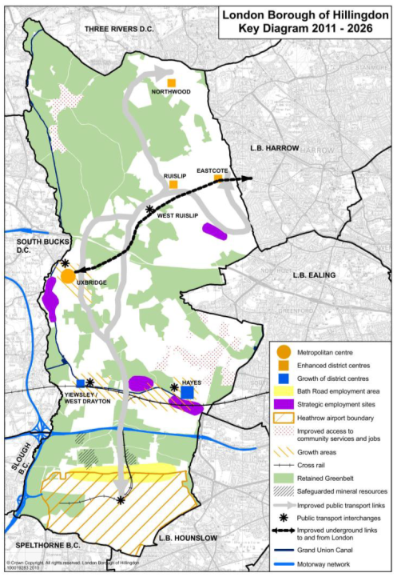
Map 4.1 Local Plan (2012)
The existing Local Plan includes 32 strategic policies. Policies of particular importance to the overall strategy and those related to employment growth and the Green Belt are:
- Employment growth is directed to the Heathrow opportunity area, strategic industrial locations, locally significant employment locations, locally significant industrial sites, Uxbridge Town Centre and Hayes Town Centre (Policy E2).
- The council seeks to maintain the current extent, hierarchy and strategic functions of the Green Belt, Metropolitan Open Land and Green Chains (Policy EM2).
Key challenges
The key challenges for the new Local Plan are thought to include:
- making the best use of previously developed land by enabling brownfield development and utilising existing and planned infrastructure to optimise density
- providing a plan-led approach to development in the Green Belt, taking into consideration changes to national policy, the introduction of ‘Grey Belt’, consideration of Green Belt assessments and evidence, and identifying sustainable locations for development
- protecting valued open spaces from inappropriate development and setting a plan-led approach to protection of open space including Green Belt land, Metropolitan Open Land (MOL) and Local Green Spaces
- building a range of market and affordable homes of different types
- providing sufficient employment and industrial space in the right locations and responding to the growth opportunities identified in the Growth Plan
- ensuring a town centre first approach is taken to certain types of development and reviewing the potential of the borough’s only Metropolitan Town Centre (Uxbridge)
- reviewing the growth potential of the Hayes and Heathrow Opportunity Areas
- managing the impacts arising from Heathrow Airport.
What the new Local Plan could achieve
The Local Plan needs to accommodate new development, including homes and space for businesses to grow, while protecting the green open spaces that are valued in Hillingdon.
The plan needs to respond to emerging issues, like supporting growth sectors and clusters, the changing office market, data centres, and the impacts of any new major infrastructure projects.