

Ellen Terry and Edward Gordon Craig
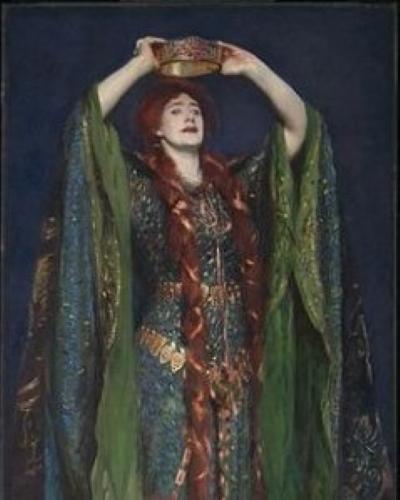
Ellen Terry (1847 to 1928) was born into an acting family and began performing on stage as a young child.
Aged just 16, she married the artist George Frederick Watts but they separated after less than a year and she returned to the stage. She then had a relationship with the architect Edward W Godwin, by whom she had 2 children - Edith Craig, born in 1869, and Edward Gordon Craig, born in 1872.
Following her divorce from George Watts in 1877, she married an actor, Charles Kelly. They soon separated and he died in 1885.
She was reputed to have had a number of affairs, notably with Sir Henry Irving in whose company she acted from 1878 to 1902.
Her final marriage was in 1906 to an American actor, James Carew - 30 years her junior. This marriage also did not last but they remained friends until her death.
On joining Sir Henry Irving's company, Ellen Terry became the leading Shakespearean actress in Britain. Her most celebrated role was as Lady Macbeth (as illustrated by John Singer Sargent's 1889 painting).
In 1887, while passing through Uxbridge, she saw a small cottage at the edge of the town and decided to rent it. This was the Brewery Tap for the nearby Colne Brewery. Throughout her tenancy, one room was still reserved for selling beer, although she is reputed to have allowed the beer to go off to discourage drinkers. She renamed the cottage the Audrey Arms, after her dresser, and spent many weekends there, entertaining many famous actors and artists.
In 1893, she transferred the lease to her son, Edward Gordon Craig (1872 to 1966), who was recently married. He lived there until 1895 and his eldest daughter was born in the cottage.
He too was an actor and became a very famous stage designer.
His first theatrical production was in December 1893 at the Uxbridge Town Hall - a performance of Alfred de Musset's No Trifling with Love.
Ellen Terry finally retired from the stage in 1920 and from films in 1922. She spent her last years at Smallhythe Place in Kent - a house she had bought in 1899.